the séance of blake manor is not a detective game
* * *
The Séance of Blake Manor is not a detective game.
Fine, it bills itself as a detective game on Steam. Reddit and Bluesky and Twitter are home to conversations like “—what’s a good detective game??? —oh you HAVE to play the seance of blake manor”. And perhaps they have a point. The setting is a dark and spooky mansion. You literally play a detective whose primary goal is to solve a disappearance. You stalk around the manor grounds collecting clues and accusing people. You have the notebook and the trench coat and the world-weary demeanor and the murky past. The Seance of Blake Manor sure seems like a detective game.
But it didn’t take long for me to realize The Séance of Blake Manor is not a detective game at all. It was quite fun in its own way, to be clear, but playing this game certainly did not make me feel like a detective. Which, for a detective game where you play a detective, felt a bit unfair. And disappointing.
This whole process made me curious… What does it mean to be a detective? And how should we feel when a piece of art lies to us about the way its premise will make us feel?
Caveat: I think this is a cool game. It is obviously fun for a lot of people. I had a good time with it, despite feeling as though the game betrayed its premise. And a bunch of talented people clearly worked very hard on it. If it looks interesting at all, go buy it and play it here. The following writing is commentary on game design and promises to players, not me saying I hate this game.
* * *
The best detective ever written, and I do not care to debate this, is Hercule Poirot. Somehow Agatha Christie managed to crank out 39 editions of the big mustache guy solving impossible crimes and they are (mostly) a joy to read from front to back. I read those books over and over again as a child and when a friend asks me how they’re supposed to get into reading, I tell them to read about Poirot.
There are a few ways you have a great time reading a Poirot book. The characters are fun. The setting is fun. Poirot himself is a fun(ny) character. But the primary way you enjoy one of these books, the thing that makes Poirot feel like a real detective, is the deduction. By the time a book with Poirot approaches its conclusion, you may have some ideas about who did the murder, but you don’t know for sure. You, like Poirot, are trying to connect the dots, to think outside of the box. And as you turn the final pages of the book and Poirot gathers all of the suspects into a room, you’re thrilled as you watch Poirot deduce; to make creative, risky, possibly unproven connections between two or more pieces of evidence.
In other words, detectives are exciting because they are doing a kind of magic.
In fantasy, there are two main kinds of magic systems: soft magic systems like in Lord of the Rings (what can Gandalf actually do?) or Game of Thrones (how did dragons really come about?). And then you have hard magic systems like in Brandon Sanderson’s Mistborn, where magic is a video game, just a matter of filling up your charge meter and pressing the right buttons in order to produce an outcome. These can both have their place, though perhaps it is obvious from my descriptions which one I prefer.
Point is, in a soft magic system, the reader does not know what—exactly—is possible. In a hard magic system, the reader knows the rules and understands what a character may (or may not be) able to do.
Most exciting detectives, Hercule Poirot included, use a version of soft magic. They collect information over the course of the book (or the show or the game), but what they are doing with that information is left unclear to the audience until the denouement. This is because, if the steps of deduction are as obvious to the reader as they are to the detective, the deduction loses its magic. The detective ceases to be a genius investigator and becomes an actor coloring in a lifeless paint-by-numbers.
Perhaps you can see the problem for The Séance of Blake Manor: how do you make it exciting when the player is the detective? When they themselves are responsible for the exciting climax? How do you encourage creative thinking and deduction when not all of your players are actually Poirot-esque geniuses? I do think there are a few clever ways you could go about it.
Unfortunately, I do not think Séance does any of them.
* * *
I should probably write about the game. There are plenty of mechanics and dashboards and mysteries to solve in Séance, but I don’t think I need to tell you about all of them. No, I think the game gives itself—its anti-detectiveness—away within the first few minutes of playing.
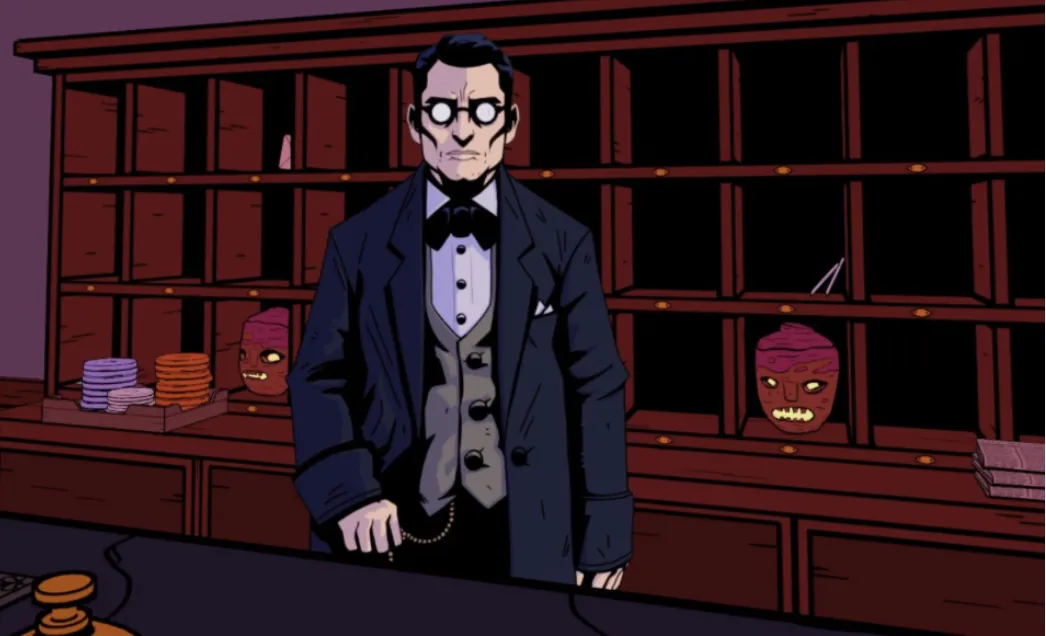
You arrive in the dark and the rain to a scary-looking mansion, having received a letter about the disappearance of a woman named Evelyn Deane. You are free to roam the grounds as you wish but it soon becomes obvious you should walk in the front door and check in. So you duck out of the weather and into a firelit reception that feels old and haunted. You slam the bell on the desk and the hotel manager appears. You are then prompted to do a very BBC Sherlock thing: you visually inspect him for clues.
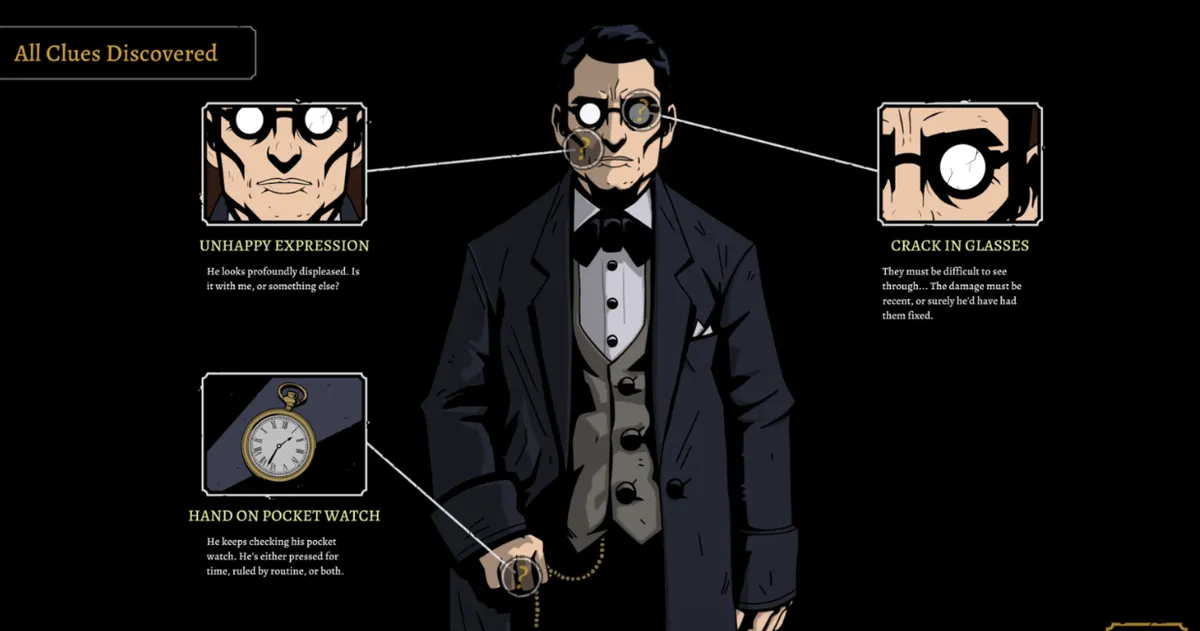
In the T.V. show Sherlock, these kinds of visual analyses are ridiculous but fun; I remember being impressed as a child when I saw Sherlock infer that somebody was an alcoholic because the area near the charging port of their phone was scuffed. It’s really quite stupid, but it’s exciting to watch because there is some Poirot-esque soft magic going on. You don’t know exactly what Sherlock is seeing, you don’t have all of the information, and it’s a joy to watch him pull the proverbial rabbit out of the hat.
In Séance, though, you are the Sherlock. So there is a game design issue… How are you supposed to do these mind-blowing Sherlockian deductions? How do we incorporate the soft magic? It’s hard to know what each player will do, what conclusions they will draw. One interesting path would be to simply not show the player any prompts at all. Let them scrutinize and magnify the portrait of this butler but do not tell them what they are supposed to infer. Let them be Sherlock; let them come to their own conclusions!
This is not, of course, what Séance does. Instead, the game highlights three highly visible clue indicators on the butler, which you scroll over with your magnifying glass. Clicking on them reveals your character’s (generally useless and banal) analysis of the clue, and it gets saved to your journal. It’s a sad and uninteresting way to start; it tells the player not to consider doing any kind of thinking on their own.
You will repeat this depressing ritual with every single character you meet over the course of the game. None of the deductions are ever really deductions, and few of the clues become relevant in any way.
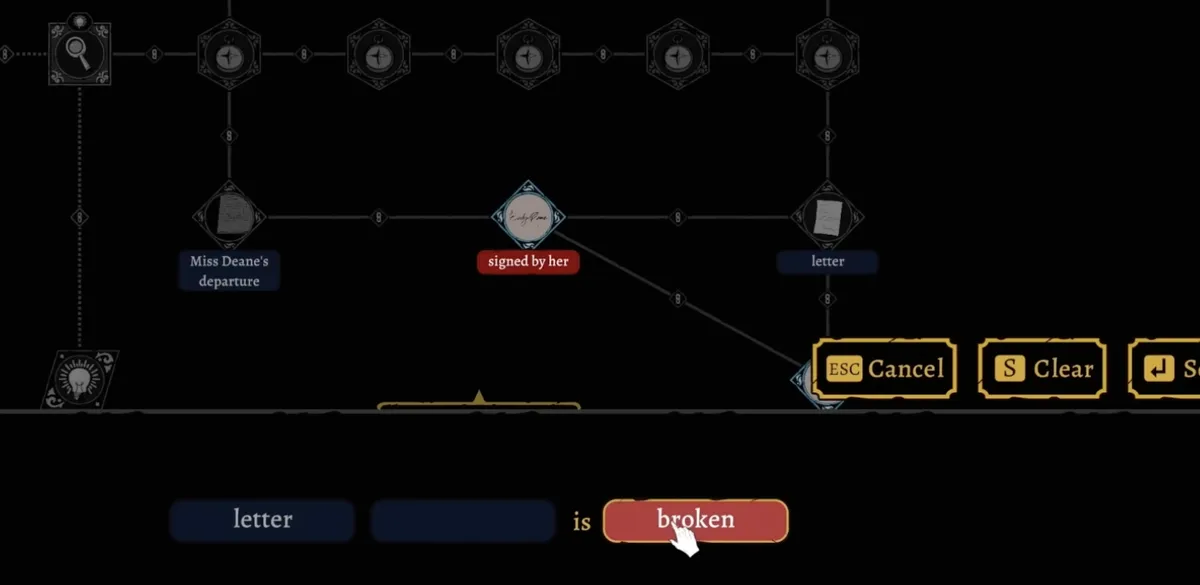
The rest of the mechanics in Séance follow the same thesis, which I’m going to start referring to as paint-by-numbers. Every character has a mystery associated with them, but solving these mysteries is simply a matter of walking around the manor and clicking on enough stuff (or having enough conversations) until you have collected the correct clues and the game announces to you that you are allowed to make an ‘accusation,’ which is (literally!) just a Mad Lib that you can try over and over and over again, with no consequences, until you get it right. This try-again mechanic is hardly relevant, though, because you will have likely solved the mystery behind each character far before the game decides that you are allowed to make the accusation. It is all supremely unsatisfying and just a bit odd.
Take the puzzles as another example. Okay, maybe the story and the mysteries need to be linear, but perhaps the puzzles are a fun way to let the player exercise their brains? No, sorry, and we’re both stupid for thinking that. Of course the puzzles are going to follow the same paint-by-numbers thesis as the rest of the game. Every single puzzle in the game consists of you trying to draw a shape in a continuous line. And, like the rest of the game, the whole process is rather arbitrary, low-strategy, and can be solved by just drawing aimlessly for a few seconds until something clicks.
(If you think about it, the puzzles themselves are almost literally a paint-by-numbers game.)
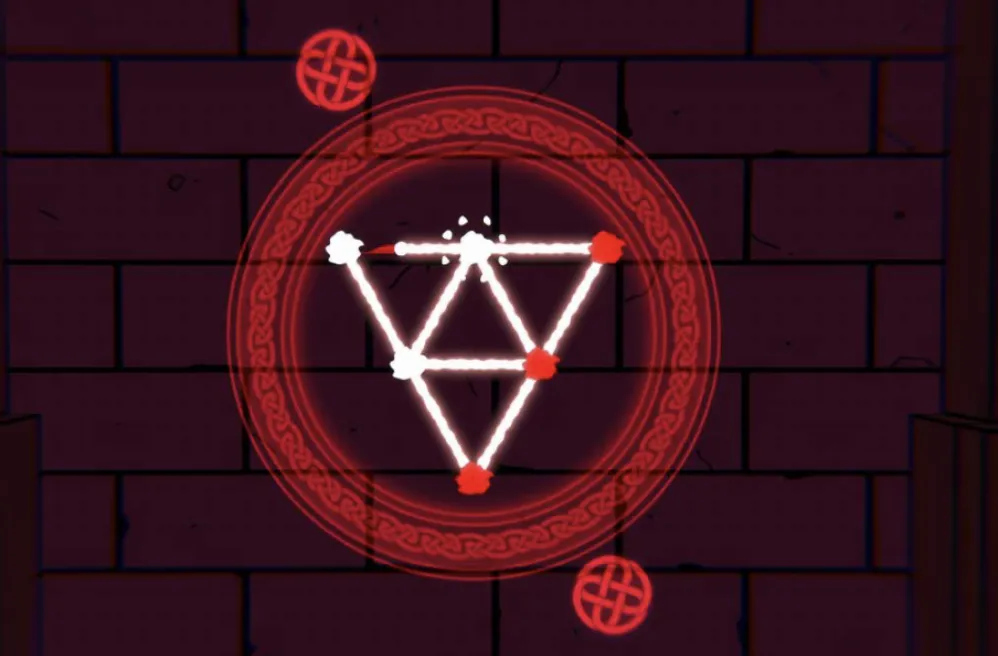
I keep saying paint-by-numbers because I cannot think of a better way to describe Séance. Watching Poirot or Sherlock work is what I imagine watching Monet paint water lilies would have felt like. Original, creative, surprising, beautiful. Playing Séance is just like filling in a paint-by-numbers: the developers have already decided what the painting should look like. They’ve decided exactly how you must paint in order to reach that outcome. They’ve decided that there should be no consequences (this game really does not want you to fail, nor does it really allow it). Just fill in the boxes, one by one, until you see the result.
I finished the game wishing that once, just once, I could have painted something my own.
* * *
I feel bad writing so much criticism about Séance because I think it is a fun game in its own right, and if the aesthetic and story look interesting to you I think you should go buy it and play it. I had a decent time with the game, in spite of everything I have written above. There is some good writing and interesting art and an obvious knowledge of Irish folklore, which is nice. But I think Séance betrays the promise it makes to the player from the start, because Séance is not a detective game.
You play a detective, yes. But you never really feel like one.
* * *
The final thought I had walking away from Séance was that making a true detective game—a game where you’re not hand-held, a game where you have to make serious deductions/decisions and where those decisions have consequences… Well, it must be a really hard thing to do. Or, at least, it must be a hard thing to do if you want the majority of people to have a good time with the game.
To make a great detective game, you probably can't do very much hand-holding. You probably need to allow for open-ended-ness in accusations. You probably need to allow the player to fail with drastic, irreversible consequences. You need to design your clue placement so that many players, from many directions, can technically arrive at the correct conclusion(s), but you need to make sure it is difficult and 'soft magic' enough that players feel like they have to make risky deductions on their own. It sounds hard!
Are there any games that really do this?
Perhaps Return of the Obra Dinn gets closer. I’ll have to play it to find out. If that fails, well, The A.B.C. Murders is on the bookshelf.
Btw: if you liked this, drop your email below and I'll email you when I write again.